
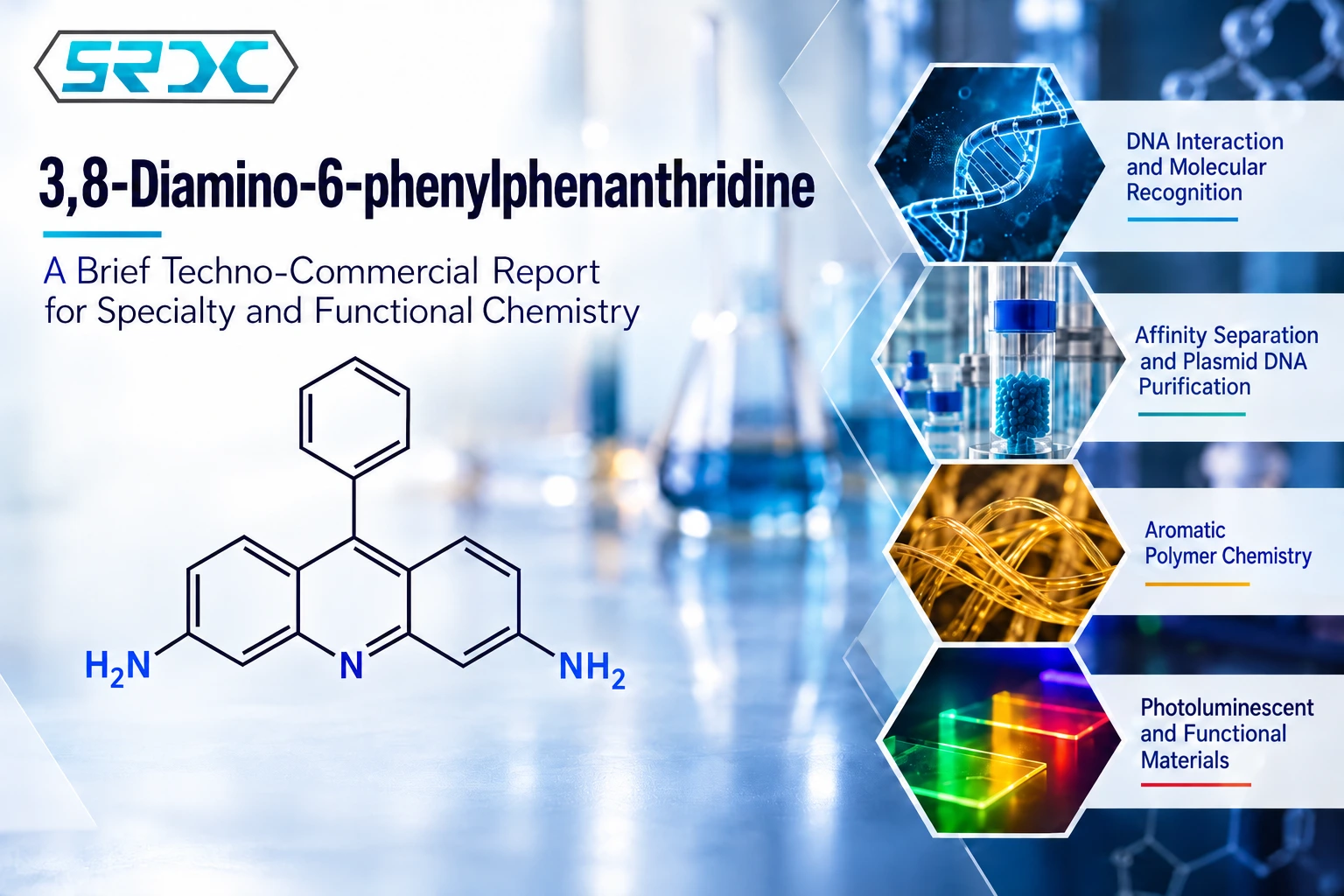
In specialty chemicals, the value of a molecule is often defined not by its volume but by the functionality it can bring to the larger chemical system and 3,8-Diamino-6-phenylphenanthridine (DAPP) is one such molecule.
With a rigid phenanthridine framework, a phenyl substituent and two amino functionalities, DAPP offers an interesting combination of structural rigidity, aromaticity and chemical functionality.
Published research papers have explored DAPP across areas including DNA interaction, affinity separation, aromatic polymers and photoluminescent materials, making it an interesting building block for specialised chemical development.
A Functional Phenanthridine Building Block
DAPP has a molecular formula of C₁₉H₁₅N₃ and a molecular weight of approximately 285.34 g/mol and its CAS No. is 52009-64-0.
Its structure consists of a fused heteroaromatic phenanthridine system containing two amino groups at the 3 and 8 positions.
From a synthetic chemistry perspective, these amino functionalities are particularly valuable.
They provide reactive sites through which the DAPP framework can potentially be incorporated into larger molecular structures, polymers or functionalised systems.
This makes DAPP interesting not only as an individual specialty molecule but also as a platform for downstream chemical modification and derivative development.
DNA Interaction and Molecular Recognition
One of the well studied characteristics of DAPP is its interaction with DNA. The phenanthridine framework has been investigated for its ability to interact with DNA through intercalation, and studies have examined the behaviour of both neutral and protonated forms of DAPP.
This molecular interaction has also been translated into separation chemistry.
Researchers have immobilised DAPP onto chromatographic supports such as Sepharose and investigated these materials for the affinity purification of supercoiled plasmid DNA.
Such applications demonstrate how the molecular recognition characteristics of a specialty chemical can be translated into functional separation systems.
With continued growth in biotechnology, gene based research and advanced purification technologies, molecules capable of specific molecular interactions remain an important area of specialty chemistry.
Applications in Aromatic Polymer Chemistry
DAPP has also been studied as a diamine building block for the synthesis of aromatic polyamides.
Incorporating a rigid heteroaromatic structure such as phenanthridine into a polymer backbone allows researchers to explore materials with distinctive structural and physicochemical characteristics.
For polymer chemists, molecules such as DAPP offer a route to introduce:
- rigid aromatic architecture,
- heteroaromatic functionality,
- nitrogen-containing structural elements and
- additional possibilities for molecular interaction.
This makes DAPP an interesting starting material for the development of specialised aromatic and functional polymer systems.
Photoluminescent and Functional Materials
Another important area of research involving DAPP is photoluminescent chemistry.
Researchers have synthesised conjugated polymeric systems incorporating DAPP units into their molecular architecture and investigated their optical behaviour.
DAPP-containing systems have demonstrated green, yellow and red photoluminescent behaviour under different structural and experimental conditions.
This highlights the potential of the phenanthridine framework in the broader field of fluorescent and optically functional organic materials.
For advanced-material research, molecules capable of combining structural rigidity with conjugated electronic systems provide valuable starting points for developing new molecular architectures.
DAPP therefore represents an interesting scaffold for further exploration in fluorescent materials, functional organic molecules and specialised optical systems.
A Platform for Derivative Development
One of the most interesting aspects of DAPP from a specialty chemical perspective is the opportunity for further molecular modification.
The presence of two amino groups provides synthetic chemists with accessible functional positions for downstream chemistry.
Depending upon the desired molecular architecture, these functionalities can provide routes toward the preparation of:
- substituted DAPP derivatives,
- functionalised phenanthridine structures,
- polymer-linked systems,
- molecular recognition materials, and
- application-specific organic molecules.
This opens possibilities beyond supplying the parent molecule itself.
A customer developing a new material or molecular system may require modifications in functionality, solubility, electronic characteristics or compatibility with another molecular architecture.
In such cases, custom synthesis and derivative development become an important extension of the chemistry surrounding DAPP.
Why DAPP is Relevant to Specialty Chemicals
DAPP brings together several characteristics that make a molecule interesting for specialised chemical development:
A rigid heteroaromatic framework
The phenanthridine system provides structural rigidity and an extended aromatic architecture.
Reactive amino functionalities
Two amino groups provide opportunities for further synthetic modification and incorporation into larger structures.
Molecular recognition characteristics
Its interaction with DNA has supported research into affinity separation and purification technologies.
Polymer-building capability
DAPP has been studied as a diamine component in aromatic polymer systems.
Optical functionality
DAPP-containing materials have demonstrated photoluminescent behaviour, supporting further exploration in functional organic materials.
Together, these characteristics make DAPP more than simply an isolated research molecule.
It represents a versatile molecular platform capable of supporting multiple directions in advanced and specialty chemistry.
From Molecular Structure to Application
The development of specialty chemicals increasingly revolves around understanding how molecular structure translates into functionality.
Molecules such as 3,8-Diamino-6-phenylphenanthridine demonstrate this clearly.
Its rigid phenanthridine core provides the molecular architecture, while its amino functionalities provide opportunities for further chemical development.
The result is a molecule that can participate in applications ranging from molecular recognition and separation chemistry to functional polymers and photoluminescent materials.
For specialty chemical manufacturers and contract research organisations, the opportunity lies in taking such molecules further — developing reliable synthetic routes, controlling critical impurities, preparing customer-specific derivatives and scaling chemistry as applications move from research toward commercial development.
3,8-Diamino-6-phenylphenanthridine is a good example of how a specialised molecular building block can open several directions for further chemical innovation.
If you are evaluating 3,8-Diamino-6-phenylphenanthridine, its derivatives, or a related custom synthesis requirement, contact us to discuss purity, quantity, development, and scale up requirements.